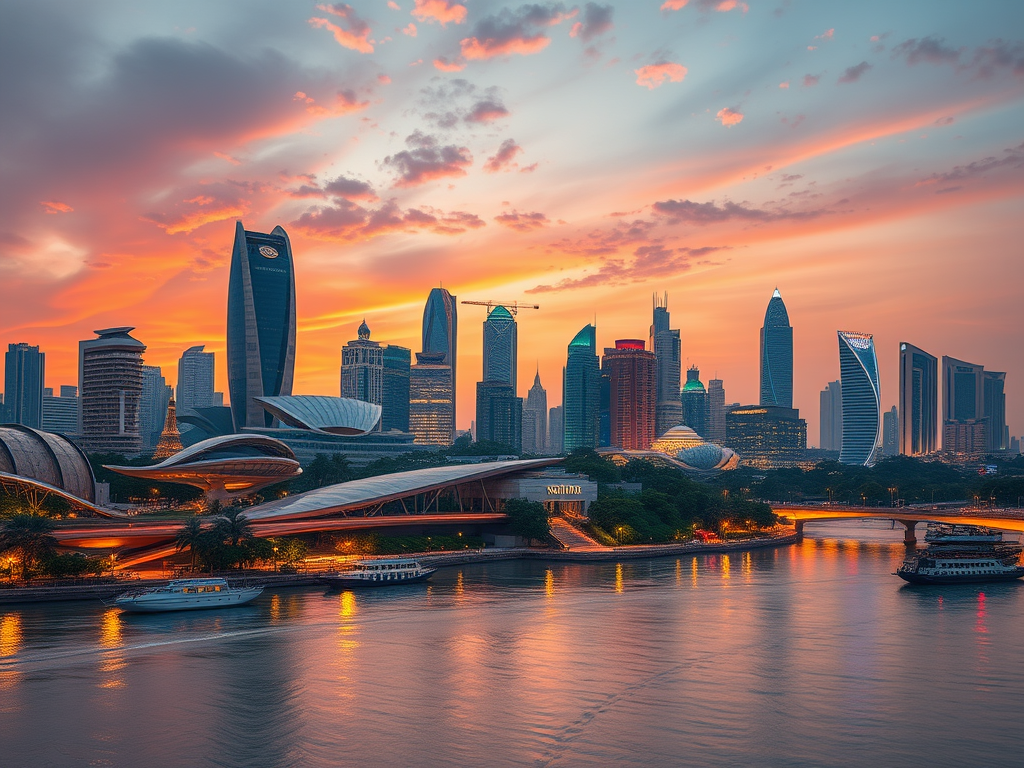
Let’s outline a Vision Document for transforming the Mumbai metropolitan region (expected population 29 Million). This ambitious vision encompasses various aspects, from education and infrastructure to culture and sustainability. Here’s a summary of your vision:
- Statehood for Mumbai Metropolitan Region (MMR):
- Advocate for MMR to be recognized as a separate state, granting it greater autonomy and focused governance.
- Economic Transformation:
- Aim for a 1 Trillion Economy within MMR.
- Strive for zero slum population by implementing comprehensive housing and rehabilitation programs.
- Education and Research Hubs:
- Establish 2 AIIMS, 2 IITs, 2 IIMs, 3 IIITs, 5 Medical Colleges, and 10 Universities.
- Develop world-class schools with capacities exceeding 900-1,200 students.
- Cultural and Recreational Facilities:
- Create 2 Animal Parks, 1 Aquarium, 1 Space & Science Park, 2 Amusement Parks, and 1 Water Park.
- Curate 100 Museums showcasing art, history, and science.
- Design lively outdoor spaces, flower gardens, and vibrant public parks.
- Heritage and Diplomacy:
- Upgrade existing UNESCO World Heritage sites and add new ones, including Haji Ali Dargah, Kanheri Caves, Marine Drive, Prince of Wales Museum, Mahalaxmi Temple, and Film City.
- Develop a Diplomatic Enclave near Vadhwan City to house World Consulates or Embassies.
- Festivals and Celebrations:
- Establish a calendar of annual events:
- Film Festival in January
- Gudi Padwa celebrations in April
- Shopping Festival in May
- Ganpati Festival in September
- Food Festival in October
- Fireworks Extravaganza in November
- Establish a calendar of annual events:
- Infrastructure and Sustainability:
- Construct 2 Major Sports Centers and multi-sports stadiums.
- Implement an Energy Grid (electricity and gas) with solar panels integrated into roads and metro tracks.
- Eliminate dumping grounds and ensure water recycling. Consider desalination for self-sufficiency.
- Mandate yearly waste management certification for public and private spaces.
- Smart Buildings and Roads:
- Design public areas and semi-public spaces to be disabled-friendly.
- Avoid compound walls for better community integration.
- Implement Green Buildings with smart heating, cooling, natural materials, ventilation, insulation, and solar panels.
- Promote rainwater harvesting to recharge the underground water table.
- Robust Transportation Network:
- Construct 4 East-to-West 6-lane access control highways and 3 South-to-North 6-lane access control highways.
- Enhance pedestrian infrastructure with bridges, bike paths, and connected urban grids.
- Promote shared micro-mobility options for sustainable commuting.
- Introduce 6,000 BEST buses with an Integrated Ticketing System for seamless travel across all modes.
- Install Electric Charging Stations on every major street.
- Create an undersea tunnel connecting South Mumbai (SoBo) to Alibaug.
- Railway Lines:
- Develop an extensive railway network:
- 488 km of Metros with 520 metro stations.
- 510 km of suburban rails with an additional 45 stations.
- 80 km of monorail with 68 stations.
- Implement Rapid Rail Transit Systems (RRTS) connecting key routes:
- BKC to Igatpuri via Thane
- BKC to Alibaug via Navi Mumbai
- Thane to Junnar
- BKC to Daman via Vadhwan Port
- Develop an extensive railway network:
- Water Metro:
- Establish a comprehensive water metro system:
- Kalyan to Vasai
- Bhaucha Dhakka to Thane
- GOI (Gateway of India) to Taloja
- Taloja to Thane
- Gorai to GOI
- Marve to Dahisar West
- Bandra to Jogeshwari
- Establish a comprehensive water metro system:
- Mumbai Port Trust (MPT) Transformation:
- Convert MPT into an International Cruise Port.
- Integrate it with the metro system and water metro for seamless travel experiences.
- Airport Expansion:
- Expand existing airports:
- Santacruz / Vikhroli (existing): Enhance capacity and facilities.
- Navi Mumbai: Develop it as a major international airport.
- Kalyan: Establish a regional airport.
- Vadhwan Airport: Create a new airport to accommodate growing air traffic.
- Expand existing airports:
Remember, this vision requires collaboration, funding, and sustained effort. This visionary plan aims to revolutionize Mumbai’s connectivity, mobility, and sustainability, Let’s work toward making Mumbai a model metropolis! 🌆🌟🚀 🚄🌊🛫
Funding ambitious infrastructure projects requires a strategic approach. Here are some potential funding sources for realizing your vision for Mumbai:
- Government Budget Allocation:
- The government allocates funds in its annual budget for infrastructure development.
- Seek budgetary provisions from the state and central governments to support your projects.
- Public-Private Partnerships (PPPs):
- Collaborate with private entities for funding and execution.
- PPPs involve joint investment, risk-sharing, and revenue-sharing models.
- Attract private investors by demonstrating the long-term viability and economic benefits of your projects.
- Borrowing and Loans:
- Secure loans from financial institutions, development banks, or international agencies.
- Consider low-interest loans or grants from organizations like the World Bank or Asian Development Bank.
- Land Leasing and Development Charges:
- Leverage revenue from leasing land parcels for commercial or residential purposes.
- Collect development charges from real estate developers for infrastructure development.
- User Fees and Tolls:
- Implement tolls on highways, bridges, and tunnels.
- Charge user fees for using public transport, airports, or other facilities.
- Special Purpose Vehicles (SPVs):
- Create SPVs for specific projects.
- These entities can raise funds independently and manage project finances.
- Bond Issuance:
- Issue municipal bonds to raise capital.
- Investors purchase these bonds, and the city repays them over time.
- Grants and Subsidies:
- Explore grants from international organizations, philanthropic foundations, or corporate social responsibility (CSR) initiatives.
- Subsidies can also support specific aspects of your projects.
- Crowdfunding and Civic Participation:
- Engage citizens through crowdfunding platforms.
- Encourage community participation and donations.
- Revenue from Operational Projects:
- Once completed, operational projects generate revenue.
- Use this income to fund future initiatives.
Remember that a mix of funding sources, transparent financial management, and efficient execution are essential for turning your vision into reality. 🌆💡💰
We should take Mumbai metropolitan city as a model example and look at each factors required to build an ideal SMART city.
Quality of Living
- Public health care
The residents of Mumbai should get complimentary health facilities under the Pradhan Mantri Social Security Schemes. Advance surgeries and treatments should be made available at affordable rates. Beds equivalent to 15% of the total population should be constructed while government hospitals like AIIMS should be built within the city parameters. One Aadhar card should be enough to get all the data on past medical history of the patient including all the medicines prescribed to the patient also called Integrated health information system. These hospitals should be aesthetically and ambience driven designed. Telemedicine should be easily available for patients if not required to visit the clinics. Psychological health clinics under mental health facilities should be developed as the cities and the families get modernize.
- Number of universities & Digital Learning Format Schools
Current with just 3 universities we need more 11-12 universities with multi-specialties courses. These universities should concentrate not on their rankings but on excelling the major fields of study. Their Teaching & learning outcome is equally important as is their Research, Citations, International acceptability and Industry feedback.
The number of nurseries, primary-secondary-higher education schools should be reflected according to the population requirement and the distance should not be more than 5 kms vicinity for every population. These schools should be with digital learning formats which enable our children to adapt to the gen-next environments.
Environment
- Environment & Pollution
As our public transport facilities develop, we need to increase the Road Tax and Increase the toll charges for the vehicles entering the MMRDA regions. Large parking stations should be arranged near to the Metro + Railway Stations and Toll Plaza.
The Sanjay Gandhi National Park (SGNP) 87 sq.km. is an important factor in Mumbai’s ecological balance. The park and the forest should be protected on all odds however the Aarey Colony land parcel allotted for the Metro Depot should go ahead. Instead, we need to look at increasing the forestation area at the places wherever its possible. Fencing should be done around the forest area to protect our wild animals as well as to protect our general public. A Singapore-Style zoo should be developed to encourage protection of our other natural habitats.
The rivers flowing through the city of Mumbai should be planned into order to increase the volume of the water by connecting with other rivers before they enter the Arabian Sea. The rivers bed should be developed in the same way as the Sabarmati Riverfront with recreation facilities, gardens, waterfalls and lighting shows to promote wellbeing and happiness as a lifestyle of the citizens.
- Energy & Waste Management
Mumbai city should be linked to the National Energy Grid, however, it should also be self-reliant. Solar and Wind energy plants should be invested at every public and private spaces. A dedicated industrial zone should be asked to produce their own 20% energy of what they consume on monthly basis. A residential and a commercial complex should be asked to produce 30% of its total energy consumption. A target of 30% of Electric Vehicles and 40% Hybrid Vehicles on roads should be the target for the next 15 years plan.
Solid or Waste Water should be recycled, used within the city premises and a target of zero-waste lifestyle should be developed. Zero Waste is a movement to reduce the amount one consumes and consequently throws away. Adopting a Zero Waste lifestyle is one of the most sustainable ways of living. Zero Waste lifestyle choices influence all environmental areas by preventing resource extraction, reducing the number of materials sent to the landfill or incinerator, and reducing pollution from producing, transporting, or disposing of materials. Privatization of Waste testing, waste segregation, Waste transportation and waste processing should be done. Recycled waste products should be sold to private industries under one brand.
Leisure
- Museums & Cultural Heritages
Museums help to provide an experience for people so that when they come to visit our community, or are moving into this region, they feel like there is a sense of vitality and sense of place and sense of vibrancy. This experience also includes a strong set of neighborhoods with distinct characteristics. A central city that gives you a sense of where you are. Amenities that attract people from a recreational standpoint, so that they are able to ride a bike on a trail, run along the riverfront, walk or play in open spaces. Museums add that spice that is part of what makes a city unique. As popular public places, museums and other cultural institutions can play a role at the heart of their communities, being involved in all aspects of daily life, both digitally and physically. This allows them to shape our future, and address real issues in society, from healthcare and welfare to employment and security.
Mumbai needs 100s of such social museums which will be a place where all stakeholders work together to create value and achieve a mission to highlight social impact and innovation in social movements in the city.
We need to develop a museum in every cultural and heritage sites of Mumbai such as the caves, forts, religious places, Bird Sanctuaries and National Parks
- Sports Facilities
A smart city doesn’t just concern the technology and digital advancements made for the citizens but also public health and physical fitness needs to be looked at for future generations. Urbanization will be one of the most powerful forces in shaping the 21st century and even with life in most cities on pause, there are many looking ahead to what will come next. For sport, this could have profound implications. We have just 3 currently but we need 10-12 such multi-sport facilities in the Mumbai. The Stadium, Arenas should be more than with 20,000 seats.
Marathons, Triathlon, Cycling and Skating events should be arranged on a periodically to encourage sports.
- Unesco world heritage
Chhatrapati Shivaji Maharaj Terminals, The Victorian Gothic and Art Deco Ensembles of Mumbai, Elephanta Caves and Global Vipassana Pagoda are only 4 such UNESCO world heritage sites in Mumbai. We should look at applying more such heritage sites to UNESCO such as Haji ali Dargah, Kanheri caves, Marine drive, Prince of Wales Museum, Mahalaxmi Temple and Film City.
- World Festival Host
Mumbai needs to annually host a world festival to bring in international and domestic tourist to the place. This will include not just high spending rich travelers but also middle-income families as well. This can Ganesh Chaturthi, Gudi Padwa but on a very large international event style events with lots of programs relating to Food, Dance, Art, Culture and Religious. Events should cover on streets, public transports, restaurants, museums, temples, malls and MICE facilities.
- Handicap friendly infrastructure
Health, Sports, Transport, Tourism, Urban infrastructure, Education, Government facilities should be disabled friendly. They should be easily and efficiently accessible to the visually impaired, speechless and wheelchair-friendly citizens of Mumbai.
Transportation
- Coastal & Inter-city Roads
A coastal road plan is under construction however there should be more such access controlled roads necessary.
- Western Coastal Road
Nariman Point to Kandivli via Priyadarshani Park, Haji Ali, Worli, Bandra, Juhu, Oshiwara, Malad
- Northern Coastal Road
Kandivli to Virar via Gorai, Vasai
- Underground Tunnels linking
- Thane and Borivali
- Bhandup to Malad
- Ghodbandar Road and Dahisar
- Powai to Vasai
- Mumbai Transport Corridors
An Integrated Ticketing System (ITS) where a commuter who alights from a train and hops on to a bus doesn’t have to buy a ticket all over again. This means that one doesn’t have to get into a bus or go to a railway station to buy a ticket -one can travel on the Metro, Central and Western Railway, buses, and even use the Monorail on a single ticket. The rickshaws and taxis under the government administration should also be linked to the same system. Following are the proposals and under construction routes :-
| Line | Mumbai Metro | Length (km) | Stations |
| 2 | Dahisar – Charkop – Andheri West – Mandala | 42.1 | 39 |
| 3 | Colaba – Bandra – SEEPZ | 33.5 | 27 |
| 4 | Wadala – Ghatkopar – Mulund – Thane – Kasarvadavali- Gaimukh | 35 | 34 |
| 5 | Thane – Bhiwandi – Kalyan | 24.9 | 17 |
| 6 | Lokhandwala – Jogeshwari – Kanjurmarg | 14.5 | 13 |
| 7 | Dahisar (East) – Bandra (East) | 16.5 | 13 |
| 7A | Andheri – CSMIA | 3.17 | 2 |
| 8 | CSMIA T2 – NMIA | 35 | |
| 9 | Dahisar (East) – Mira – Bhayander | 10.3 | 8 |
| 10 | Gaimukh – Shivaji Chowk (Mira Road) | 9.2 | 9 |
| 11 | Wadala – CSMT | 12.7 | 11 |
| 12 | Kalyan – Dombivali – Taloja | 20.7 | 17 |
| 13 | Mira Road – Virar | 23 | |
| 14 | Kanjurmarg – Vikroli – Ambernath – Badlapur | 45 | |
| 15 | Mahapalika Marg (Thane) – Borivali (underground) | 6 | |
| 16 | CSMT – Chembur – Vikroli – SarvodayaNagar – Nahur – Kalwa – Airoli | ||
| Line | Navi Mumbai & Thane Metro | Length (km) | Stations |
| N1 | Khandeshwar – CBD Belapur | 23.4 | 20 |
| N1A | Khandeshwar – NMIA | 1 | |
| T1 | New Thane – Lokmanya Nagar – Wagbil – Balkum – Thane Station | 29 | 22 |
| Line | Monorail | Length (km) | Stations |
| M1A | Jacob Circle – Ghatkopar Railway Station (Extension) | 6 | |
| M1B | Mahalaxmi R. Station – Babulnath Temple (Extension) | 5 | |
| M1C | Wadala – Chunabhatti – Bandra (Extension) | 8 | |
| M2 | Sewri – Worli – BPT Hospital | 12 |
| Line | Suburban Extentions | Length (km) | Stations |
| SRB 6 | Panvel – CSMT (Elevated) | 48 | 11 |
| SRB 7 | Virar – Churchgate (Elevated) | 63 | 26 |
| SRB 8 | Panvel – Diva – Vasai (New Line) | 77 | 20 |
| Line | Mumbai RRTS | Length (km) | Stations |
| MRRT 1 | BKC – Thane – Vikramgad – Igatpuri | ||
| MMRT 2 | BKC – NV Mumbai – Alibaug | ||
| MMRT 3 | Thane – Junnar | ||
| MMRT 4 | BKC – Virar – Daman | ||
| MMRT 5 | BKC – Muscat – Dubai (fully underground) |
| Line | Mumbai Water Metro Route Origin |
| SOBO to Navi Mumbai Line | Starting from Colaba, this line will pass through Nariman Point, Cuffe Parade, and Fort, then cross the bay to reach Vashi and Palm Beach Road in Navi Mumbai. Approximate distance: 35 km. |
| Eastern Waterfront Line | Connecting Wadala, Sewri, and Chembur with Thane and Kalwa along the eastern waterfront, providing a smooth link to Navi Mumbai via Airoli. Approximate distance: 32 km. |
| Western Waterfront Line | Starting from Bandra, this line will run along the western coast covering Juhu, Versova, and Malad, then extend to Borivali and Mira-Bhayandar. Approximate distance: 34 km. |
| Central Waterfront Line | Linking Dadar and Mahim with Kurla and Ghatkopar, then extending to Kalyan and Ambernath, this line will enhance connectivity to the central suburbs. Approximate distance: 40 km. |
| Southern Waterfront Line | Beginning at Gateway of India, this line will cover Alibaug, Mandwa, and Karanja, extending to Uran and further reaching Panvel, connecting the southern coastal areas with Navi Mumbai. Approximate distance: 45 km. |
| Vadhvan Port Line | Starting from Borivali, this line will cover Dahisar, Mira-Bhayandar, Virar, and Palghar, ultimately reaching Vadhvan Port. Approximate distance: 50 km. |
 How Reforms Should Look Like
Leave a comment