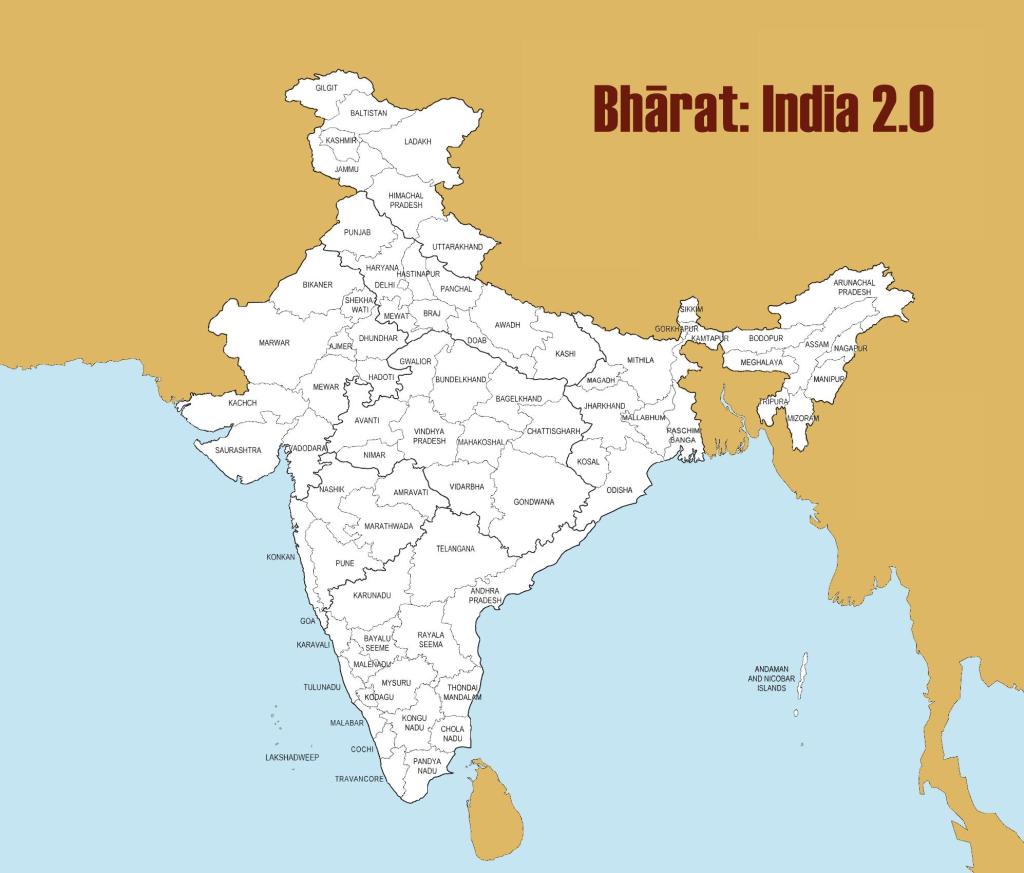
Quite controversial topic but we need to see what unites India and then talk about why it’s important to have smaller states than the gigantic states we have. We would look at the pros and cons too. This subject is very interesting and close to many hearts. Looking at the current population and its growth we should be ideally a union of 50 states of India (if not 75).
Are we a nation or a Union?
India is a Union and not a nation. A nation is usually created based on one language, religion and culture. People living in a nation typically have a strong sense of belongingness which in turn creates a sense of one identity and a higher nationalism. Unity in a nation is very strong. On the other hand, a country is just a collection of different cultures, religions, and languages forced to attain a single identity. There is a very weak sense of belongingness and therefore a fragile unity. We are a union through a political situation and so clearly, India is not a nation it’s a Union.
India, being a country, has a very weak unity among its people. People living in the Northern part of India do not understand the people of the south. There is no real belongingness among different cultures, languages, and religions in India. People do not subscribe to a single national identity. The different States of India can be considered separate Nations.
What unites India?
After a creation of Pakistan its very unlikely that another partition would take place. The partition clearly demonstrated to India the crisis a country goes through such as the state of Pakistan is now. No one would endanger this safety, security and freedom of speech which India gives. There will be voices from political front at many intervals but the migration of inter-state labour will help to keep the movement and communication uninterrupted. Hinduism plays a very important role in India it’s a silent unspoken bond which keeps us united. Hinduism helps us to accepting and respecting other customs and religions. Unity in Diversity was a major slogan in school of 90’s, BJP has somehow stressed on One-Nation policies which might be harmful in the future if stretched too much. Linguistic pluralism is the first of the three major design elements responsible for Independent India’s unity, development and dynamism. The second is our federal structure. Ambedkar explained that “The States, under our Constitution, are in no way dependent upon the Centre for their legislative or executive authority. The Centre and the States are co-equal in this matter.” The third of these pillars is fiscal federalism: for, as even high schoolers know, how money is raised, shared and spent by its members is crucial to the survival and success of a club.
Factors that might harm the unity
Population in one side of the country will be disastrous and therefore fertility rate should be under control with next 5 year before the delimitation exercise takes place. It will not help while increase the seats in Parliament but it will surely calm the waters a bit. Increase in Muslim population might also be a factor which might affect the unity. Strong regionalism criticizing the India or Indianness should be dealt with immediately.
Proposed Reorganisation of India
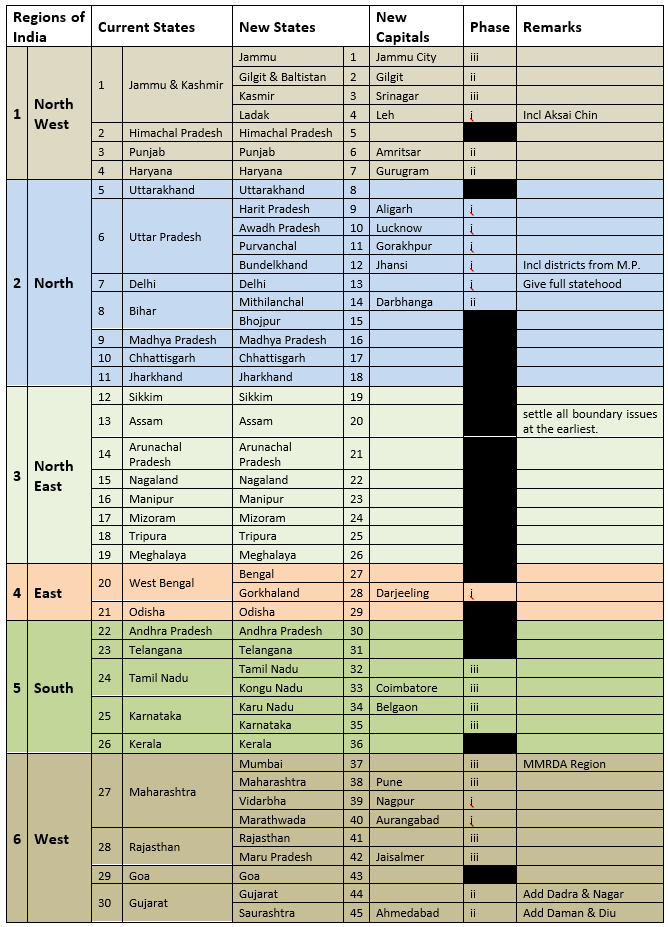
Phase 1 of Reorganisation
Uttar Pradesh, Maharashtra, West Bengal, Jammu & Kashmir and Delhi should be taken into consideration at earliest. Uttar Pradesh if considered a country will be the 8th most populated country in the world.
Uttar Pradesh
Needs to be divided into 4 parts namely:- 1) Harit Pradesh (or Braj) with Aligarh as its capital, 2) Awadh Pradesh with capital as Lucknow, 3) Purvanchal (or Kashi) with capital Gorakhpur and 4) Bundelkhand with capital as Jhansi. Bundelkhand of Madhya Pradesh will be integrated with it mother state this time.
Maharashtra
Maharashtra will be also divided into 3 parts namely :- 1) Vidarbha with capital Nagpur, 2) Marathwada with capital Aurangabad and 3) Rest of Maharashtra will remain same.
West Bengal
The demand of Gorkhaland will be accepted, if there is a consensus it can also be called Gorkha Pradesh. The capital will be Darjeeling. Its doesn’t need to be a full state as yet can be done by Phase 3, to start with it can be Union Territory for now.
Delhi
Full statehood will be given to Delhi and the reorganization will also give additional regions of NCR region for its sustainability. A larger Central Vista Area including the forest from both sides will be removed from the Delhi state limits and would be taken over by the Ministry of Défense. A V.V.I.P helipad with a underground access from the PM’s residence and Rashtrapati Bhavan will be built from where the President and Prime Minister can be escorted to the Indira Gandhi Airport during emergency.
Jammu, Kashmir & Ladak
As on 5th August ’20, Ladakh was carved out of Jammu & Kashmir which was already under our Phase 1 plan.
Phase 2 of Reorganisation
Phase 2 looks at Punjab, Haryana, Gujarat and Bihar. Bihar though important could be taken up along with Uttar Pradesh in the 1st Phase.
Bihar
State of Bihar actually needs to be divided into 4 states looking at their population but as of Phase 2 we propose to create two states Mithilanchal with capital Darbhanga and Bhojpur with capital Patna. These two states are very important for country overall developmental statistics.
Punjab, Haryana & Chandigarh
Well its time that both the states create their own capitals and Chandigarh is allowed to function on its own. They should have no say in the planning and security of Chandigarh. Punjab capital to be Amritsar and Haryana’s capital to be Gurugram.
Gujarat
Saurashtra should be carved out with a capital Ahemdabad.
Gilgit & Balistan
We assume that a state government in excile or a physical integration of Gilgit & Balistan state is under India’s control by the time Phase 2 of the reorganization takes place. Gilgit will be the capital of Gilgit & Balistan.
Phase 3 of the Reorganisation
This is a very important phase to have multiple smaller states under Union of India to be a truly united state of India. Jammu, Kashmir, Tamil Nadu, Karnataka, Maharashtra and Rajasthan are states to look into.
Jammu & Kashmir
Jammu and Kashmir will be separated with Jammu City and Srinagar as their capitals to be named respectively.
Tamil Nadu & Karnataka
Kongu Nadu with capital Coimbatore and Karu Nadu with capital Belgaon will be carved from these original states. There are more complicated demands from the different regions. Economic stability and region aspirations both should take precedence.
Rajasthan & Maharashtra
Maru Pradesh to be carved out with a capital Jaisalmer. Mumbai as a MMRDA region (including Thane, Kalyan & Navi Mumbai) with a capital Nariman Point needs to be carved out for better functioning. Konkan, Khandesh and Pune regions can be looked into as well in this Phase.
Why smaller states
Not just smaller but empowered states where their laws, their culture, their language, literature, their tribal’s are protected. This will create efficient Bureaucracy, better implementation of laws and better management of BPL families. Building new capital needs good capital but infrastructure building opportunity in an under-developed part of the country. New courts, new universities, and new hospitals will help speedier the delivery of government services. Each State assembly should not be less than 100 seats this will enable to have a wider range of sub-regional parties and better collision governments. We have seen unclear mandates of smaller states with no majority party who is able to stake claim of the government. The value of each MLAs as stated in our constitution is not same in every state. So the value of a MLA in a bigger state representing larger population will have a greater value than a small state MLA at the time of Presidential elections.
Pros for new smaller states
- Local issues will be given more importance
- Access to capital of the state will be nearer
- Will create more cities and generate need for more infrastructure. Especially building a new Capital will encourage more fund allocation from the Central government.
- New Vidhan Sabha and Separate Budget will include proper funding from the union directly to the last person of the food chain. more flexible and better at reacting and adapting to challenges.
- Separate state Election Commission, Public Service Commission, separate cadre for IAS/IPS/IFS (F: forest service), Human Rights, Women’s , SC/STs and Child Commissions – will promote democracy to the last mile. Simpler administration, proper governance and targeted policy-making, the chance of more conventional policy implementation, and even utilization of central funds are the major benefits people can enjoy
- A separate high court will help give justice to the population’s doorstep
- Local Tribes and Adivasis can get better reservations and protection to their culture with better understanding.
- Local dialects will be protected
- Inter-state healthy competition will help in increasing our ease of doing business and ease of living ranking in the world.
Cons of have smaller states
- Building up regionalism and might end up affecting the unity of the country. Fanatic regionalism is a roadblock to development. We are Indians first, and smaller states could become a problem in that line of thinking.
- Smaller states can also lead to the hegemony of the dominant community/caste/tribe over their power structures. In such states, aggressive regionalism too can develop and lead to the growth of the sons-of-the-soil phenomenon and consequent intimidation of the migrants.
- Factors used to divide the state are very important. If it’s linguistic or for purely economic reasons.
- Instead of dividing the states it might be better to divide the districts into smaller ones in order to micro manage the deficiencies affecting Ease of Living Index.
- Building capitals are costly and might take away funds allotted for poorer sections of the society for which a state was created.
- The economy of smaller states if revolves around agriculture and natural resources. One bad rain year could run havoc on the tax collection.
- Confusion and anarchy created by the formation of separate states have lead to deaths and destructions in the past.
- Inter-state water dispute will be a major challenge in future.
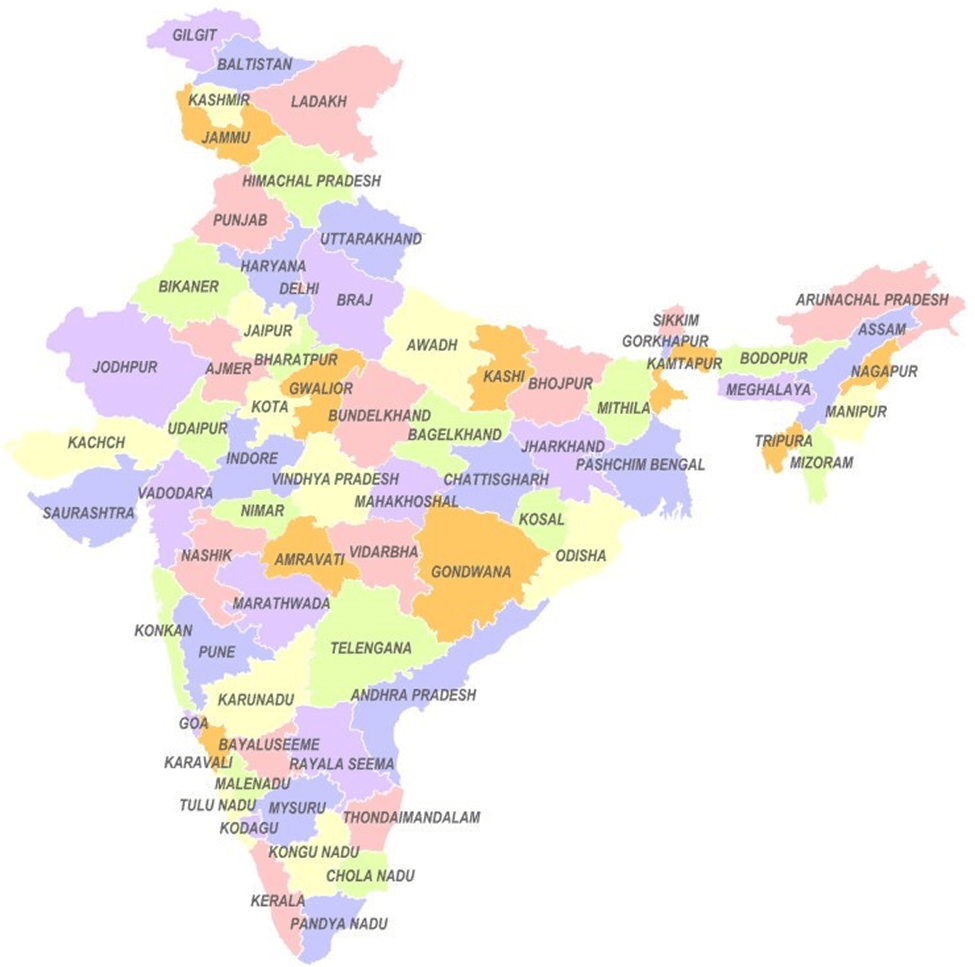
Bharat 2.0 – 75 states
Map suggested by Shri Gautam Desiraju adapted from twitter handle @hodlvolk
However, Shri Gautam Desiraju further creates difference zones for Team India. Himalayan Zone, Northern Zone, Central zone (including Vidarbha), Western Zone (not including Marathi speaking states), Souther-West Zone, Southern Zone, North-eastern Zone (from Gorkhaland and Kamtapur) and East Zone (including Magadh and Mithila). Earlier when dividing our country into 50 states there was special attention to ensure that none of the states should have Muslim dominated population. I guess this is because the past-horrific-tragic experience we suffered when dealing with Kashmir. Shro Desiraju however with this proposal creates not just Kashmir but Gilgit, Baltistan, Hastinapur, Maghadh and Mallabhum.
 How Reforms Should Look Like